Saturday, 8 October 2011

L' Express review of the French Edition of Quantum

A review of the French edition of Quantum, or Le grand roman de la physique quantique as it's called in France, published in June but just forwarded to me by a friend:

'Bruxelles, octobre 1927. L'élite des physiciens de la planète est réunie au parc Léopold pour le congrès le plus important et le plus dramatique de la physique moderne. Dix-sept des vingt- neuf personnalités sont des Prix Nobel ou de futurs Nobel, dont Marie Curie, seule femme de cet aréopage d'hommes. Thème officiel : électrons et photons. En réalité, ces savants doivent accepter ou rejeter les premiers éléments de la physique quantique. Et remiser au placard les théories de la relativité qui ont valu à Einstein son prix Nobel en 1921. C'est un choc de titans, chacun affûtant ses armes pour ou contre le "quantum" pour lequel Max Planck a reçu le Nobel en 1919. La plupart de ces hommes se connaissent, ont même travaillé ensemble. Pourtant, la lutte sera sans merci. Acculé par ses pairs, Einstein se bat comme un lion.

Le talent de Manjit Kumar, physicien et philosophe, est de nous faire vivre cette bataille en direct, comme les étapes qui l'ont précédée et les années de conflit qui ont suivi. Il nous fait entrer dans l'intimité de ces génies, leurs origines, leurs engagements, leur passion pour cette science qui est en train de vivre sa plus grande révolution. On les suit depuis l'enfance jusqu'à la recherche de l'université européenne ou américaine qui veut bien les accueillir pour des travaux rarement pris au sérieux. Alors qu'ils ont donné naissance à tout ce qui fonde la modernité, depuis l'atome jusqu'à l'ordinateur. L'arrivée de Hitler au pouvoir en Allemagne force les savants juifs à s'exiler. Dans les années 1950, la commission McCarthy chasse d'Amérique les chercheurs de gauche.
L'auteur analyse avec brio les différentes thèses, expose les méthodes. Il sait aussi remettre dans son contexte l'apostrophe célèbre d'Einstein - "Dieu ne joue pas aux dés" - et l'invention par Erwin Schrödinger de ce chat mythique, vivant ici tandis qu'il est mort là-bas. Surtout, il nous fait suivre les péripéties du combat, partisans de Planck et de Bohr contre admirateurs d'Einstein. L'affrontement est si violent qu'on attend avidement chaque nouvel épisode, comme s'il s'agissait d'un film policier qui serait intitulé "le grand thriller du quantique". Aujourd'hui, alors que la théorie qui réconcilierait la relativité et la physique quantique apparaît encore comme un Graal inatteignable, il est bon de méditer sur cette épopée.'

Wednesday, 27 July 2011

A Review of the Spanish edition of Quantum


A review of the Spanish language edition of Quantum published today by Noticias de la Ciencia y la Techologia:

'Aunque la ciencia sigue avanzando de forma imparable, hubo una época en la que la física hizo un enorme e inesperado salto adelante. Esta era brillante se cerró durante el Quinto Congreso Solvay, en octubre de 1927, donde se reunieron 29 físicos, 17 de los cuales eran o acabarían siendo premios Nobel. Basta con observar la fotografía conmemorativa de la reunión para certificar su importancia: Schrödinger, Pauli, Heisenberg, Dirac, de Broglie, Bohr, Planck, Einstein, Curie, Lorentz... Suficiente materia gris como para cambiar el mundo.

El más famoso episodio de este congreso fue sin duda el debate entre Einstein y Bohr, dos de los mayores investigadores y teóricos de la historia, y dos científicos que ofrecían visiones no coincidentes de la realidad. Hubo otros congresos Solvay, y otros encuentros entre ambos físicos, pero ninguno como el de 1927. Sus teorías rivales fueron un estímulo brutal para ellos y para sus seguidores, que así hicieron avanzar la física de forma decisiva.

En “Quántum”, Manjit Kumar nos ofrece una amplia perspectiva histórica sobre la ciencia cuántica, y nos cuenta lo que ocurrió en Solvay y entre las personalidades que allí concurrieron. Es una historia de ciencia, pero también filosófica, de rivalidades, de personas.

El libro es una obra de divulgación científica tanto como un texto de historia y una biografía. Es así como consigue atrapar al lector, quien en sus páginas aprenderá sobre física cuántica y más aún sobre los individuos que desarrollaron la teoría, en un entorno de trabajo de principios del siglo pasado.

Por esta vía, Kumar, que es también físico, ha dado a luz un libro que se ha convertido en un auténtico éxito en Gran Bretaña y otros países. Y no es extraño, pues el producto es el fascinante relato de un debate entre dos genios, y al mismo tiempo, una obra que trata de contarnos dos visiones distintas de la naturaleza de la realidad.

Sin duda, estamos ante un libro para disfrutar desde múltiples puntos de vista. El interesado por la historia de la ciencia, el amante de la física, el lector de la filosofía moderna, el estudiante, todos encontrarán algo provocador y atractivo en él. No deben perdérselo.'

You can read an extract in Spanish here.
Translation to follow once I can convince a Spanish speaker to translate...

Thursday, 21 July 2011

James Hannam reviews Quantum

James Hannam, author of God's Philosophers: How the Medieval World Laid the Foundations of Modern Science reviewed Quantum on his blog - Quodlibeta. I've taken the liberty of reproducing it below:

'Manjit Kumar’s book Quantum: Einstein, Bohr and the Great Debate about the Nature of Reality is a difficult project triumphantly accomplished. In popular history of science, the aim is to mould the history and the science together without compromising too much on either. When the science in question is quantum mechanics, an author already has his work cut out trying to explain it to the general reader. Another challenge is that the history of the quantum is about a clash of personalities and philosophical viewpoints. Turning that into a readable story is no mean feat. But Kumar has succeeded on both fronts.

The debate at the heart of Quantum is how to interpret the strange physics of the sub-atomic world. On one side was Albert Einstein. Despite the difficulty many of us have with relativity, it is actually a well-behaved physical theory that does not require us to compromise on the basic concepts of objective reality or cause and effect. Quantum mechanics, on the other hand, disposes of such foundations: it is a subjective realm where the observer appears to affect the result of experiments and where randomness is indelibly built in. Einstein could never accept this. He thought there were “hidden variables” behind quantum mechanics that would transmute it into a deterministic theory. “God does not play dice”, he said many times.

The other side of the argument was led by Niels Bohr, the greatest Dane since Tycho Brahe. Bohr developed the Copenhagen interpretation of the quantum which embraced its strangest aspects. Bohr accepted that the motion of sub-atomic particles can only be predicted as probabilities and that the experimenter is part of the same system as the thing being observed. Einstein set Bohr a number of fiendish puzzles to show that quantum mechanics was inconsistent and so incomplete. But every time, Bohr solved the problem. Eventually, after Einstein’s death, the Irish physicist John Stewart Bell developed a way to experimentally test one of the quantum paradoxes called non-locality. But, to date, the theory appears to pass even this trial.

All this has left science with a massive hangover. It is not as widely appreciated as it should be that the two crowning achievements of modern physics, relativity and quantum mechanics, are completely incompatible. It is not just that they give different results. They inhabit different metaphysical universes. Scientists have tended to assume that quantum mechanics is the more fundamental theory and string theory is an attempt, unsuccessful so far, to combine it with relativity.

I have a suspicion that current crisis in physics is a function of abandoning the metaphysical framework of a deterministic and objective universe. String theory has returned to the failed ancient Greek model of pure rationalism where clever ideas can never be tested. In the meantime, anyone who wants to understand the background to the The Trouble with Physics chronicled by Lee Smolin can do no better than to read Manjit Kumar’s Quantum.

If you haven't read James's book, check it out. It was shortlisted in 2010 for the Royal Society Science Book Prize.

Wednesday, 20 July 2011

'a brilliant history of quantum theory'

A review of Quantum by Paul Thomas on the Freedom in a Puritan Age website:


'Quantum mechanics is both one of the most important scientific theories of the twentieth century and one of the least understood, admittedly even by physicists themselves. Quantum theory challenges both the laws of ‘classical physics’ and throws up philosophical questions about our ability to truly understand, not just the microphysical world of the atom, but the everyday, macrophysical world which we inhabit.

In telling the story of quantum theory, Kumar has written a fascinating narrative history that interweaves scientific theory and individual biography against the background of broader historical events.

Kumar introduces us to not just the main adversaries around whom the debate over quantum theory revolves — Albert Einstein and Niels Bohr — but a supplementary cast of some of the greatest scientific minds of the twentieth-century: the conservative patriarch of modern science, Max Plank; charismatic New Zealander, Ernest Rutherford; dogmatic quantum theorists Werner Karl Heisenberg and Max Born; the ‘shy’ Paul Dirac; Wolfgang Pauli, known as “The Wrath of God” for his critical mind; the ‘scandalous’ (and sometime alley of Einstein) Erwin Schrodinger; and post-WWII Irish scientist John Bell, who came up with a famous theorem to test Einstein and Bohr’s positions. At the heart of the book though is Einstein, the most famous scientist in history, the man whose name has become a synonym for ‘genius’, and whose continued questioning of a theory he had helped initiate saw him become an increasingly isolated and discredited figure.

Quantum theory begins in 1900 with Max Planck’s discovery that the energy of light and all other forms of electromagnetic radiation could only be emitted or absorbed by matter in ‘bits’, bundled up in various sizes; ‘quantum’ being the name he gave these individual packets of energy. As Kumar says, this was a radical break from the long held belief that energy was emitted and absorbed continuously. For Planck, the quantising of energy was a pragmatic solution to another problem that he thought he would get rid of in time.

Einstein saw the revolutionary and ‘heretical’ potential of Planck’s temporary expedient. In 1905, Einstein published four papers that would eventually launch him to international stardom, including his special theory of relativity. But it was the first of these papers, in which he put forward the theory that light was made up of particle-like quanta or photons (as they were later called), that Einstein considered the most important.

In 1913, the young Bohr applied Einstein’s light-quanta theory to the electrons within an atom and their ability to emit or absorb energy; but in doing so, he violated certain tenets of accepted physics, leaving what happens within the atom completely to chance. For Einstein, it was as if one were to let go of an apple, but instead of it falling to the ground it was suspended for some unspecified length of time, before shooting off in some undetermined direction.

Nevertheless, as with Planck and his original ‘bundles’ of energy, Einstein was prepared to abandon the ‘causality’ of classical physics and tolerate random ‘probability’ for the time being, in the hope it would be removed with further scientific developments.

By the mid-1920s, however, Einstein had grown uneasy with the very probability he had introduced into the atom. It was in writing to Max Born about his theory in 1926 that Einstein expressed his growing disquiet about quantum mechanics, and in which he first uttered his famous remark that ‘God is not playing dice’. Nevertheless, he had been the unwitting inspiration for one of the greatest developments in the understanding of the quantum: Heisenberg’s uncertainty principle.

Heisenberg had discovered that quantum mechanics forbids the precise determination of both the position and the momentum of a particle at any given moment. The more accurately the one is measured, the less accurately the other can be known or predicted, as any attempt to measure an electron automatically interferes with its trajectory. As such, for the likes of Bohr, Heisenberg, and what became known as the Copenhagen school of quantum mechanics, there can be no such thing as a quantum reality free from observation. An electron simply does not exist at any place until a measurement is performed to locate it. It is the act of observation that makes ‘real’.

For Einstein, and a few like Schrodinger, there must be an objective reality free from observation and accessible to human reason. This isn’t just a scientific question, but a philosophical one. The belief that there is no such thing as an observer-free objective reality in the atomic realm affects what we can say about nature in general and, for Einstein, risks reducing science to ‘uninspired empiricism’. However, although this is ‘the great debate about the nature of reality’ to which Kumar refers, this is an argument that is never fully had-out between the main protagonists; as Bohr, unlike Einstein, is clearly not keen to step outside the uncertainty of the subatomic realm and into a real-world philosophical debate.

Amongst the strengths of Kumar’s account is placing these debates within their historical context. The uncertainty at the heart of quantum physics reflected the uncertainty of the inter-war years, which eventually saw Einstein emigrate to the United States, and brought an end to the international conferences at which these debates took place. But Kumar’s real achievement is to rehabilitate the reputation of the later-Einstein, on whose side you have no doubt Kumar is.

From the beginning Einstein argued that quantum theory was incomplete; yet as its application became increasingly successful, he became marginalised and an almost lone voice against the increasing orthodoxy of the Copenhagen Interpretation. Today, however, many physicists would agree with Einstein that quantum mechanics is an incomplete theory. As Kumar says, although Einstein never managed to deliver a decisive blow in his encounters with Bohr, his challenge was sustained and thought provoking:

“Einstein never put forward an interpretation of his own, because he was not trying to shape his philosophy to fit a physical theory. Instead he used his belief in an observer-independent reality to assess quantum mechanics and found the theory wanting.”

Kumar has written a brilliant history of quantum theory from its origins to the present; capturing, in particular, the excitement of the interwar years as the greatest scientific minds of the twentieth-century criss-crossed Europe, between conferences and university departments, meeting in train stations to snatch every opportunity to discuss the latest theories. Quantum evokes that world and takes you into those complex debates, without distracting from a fascinating story.'

Wednesday, 29 June 2011

Quantum - Spanish Edition


The Spanish edition of Quantum is now available online here and in bookshops throughout Spain thanks to Peter Tallack and Louisa Pritchard. Many thanks to my translator David González Raga, María Alasia and everyone else involved in its production at Kairos.

Sunday, 12 June 2011

Quantum - Italian Paperback Edition


The Italian paperback of Quantum was published at the end of May and is available online here at Italian Amazon and in bookshops throughout Italy. My thanks to all those involved in its production at Mondadori by especially to my Italian translator Tullio Cannillo.

Monday, 9 May 2011

Quantum paperback published in USA and Canada


Today Quantum is published in paperback in the USA and Canada. Thanks to everyone at Norton. Love the new cover. You can buy it online here.

Tuesday, 26 April 2011

Quantum in paperback in French and German


Quantum is now available in French and German paperback editions and on sale, as they say, in all good bookshops in France and Germany.

You can buy the French here and the German here

Monday, 25 April 2011

Solvay 1927 - A film clip

If you want to see some extremely rare footage of some of the participants leaving the Solvay conference in October 1927. Shot by the American Irving Langmuir, its just under 3 minutes long and shows Einstein, Bohr, Schrodinger, Heisenberg, Pauli, Born, de Broglie, Dirac and others after a day discussing quantum mechanics. The commentary is provided by Nancy Thorndike Greenspan, the author of an excellent biography of Max Born called The End of the Certain World.

Tuesday, 12 April 2011

'An Enlightening Book on Einstein and the Quantum Theory Debate'

Jay Lehr, science director of the Heartland Institute reviews Quantum:

'While I was a student at Princeton University in the early 1950s I had a literally nodding acquaintance with Albert Einstein. During my freshman year he walked past my dormitory every day on his way to the Institute for Advanced Study. I often found myself on the sidewalk as he passed by, and we nodded to each other. I have read many an interesting biography of his life since, but none more interesting than Quantum, by Manjit Kumar.

Quantum is a biography not just of Albert Einstein’s life but also his thought processes. It also provides insight into the dozens of famous theoretical physicists who influenced and aided him in his work.

Complex Science Explained
Quantum theory, which attempts to describe the atomic and subatomic worlds, is for most people a byword for mysterious, impenetrable science. For many years it was equally baffling for the world’s most brilliant physicists. Here the author gives us a dramatic and superbly written account of this fundamental scientific revolution and the divisive debate at its core.

Simply reading Quantum may not make one an immediate expert on quantum theory, but the chronology of every great contribution to the physics of quantum theory—beginning in 1858 and continuing to the present—will be worth the price of the book.

The most complex and difficult-to-understand intricacies of quantum theory in no way reduced the joy I felt in reading this book and following the journey of so many great scientists as they researched and published their discoveries. Interestingly, these discoveries were not often verified in a laboratory, but they were agreed upon because they accorded with physical observations and allowed for reasonable mathematical solutions.

Interesting Narratives, Theories
In one of the most compelling discussions in the book, Kumar describes a conference held in Belgium in 1927. Of the 29 people invited to the conference, 17 went on to receive the Nobel Prize. At times Kumar made me feel like I was in the room. Heisenberg, Planck, Born, and Schrödinger came alive for me as I read these passages.

In an enlightening scientific discourse, Kumar explains the concept of entanglement, a quantum phenomenon in which two or more particles remain inexorably linked no matter how far apart they are. He also explains the intriguing quantum theory in which Dr. Schrodinger’s cat can be simultaneously dead and alive.

Quantum is not a book for everyone. But if you have a great deal of scientific curiosity and enjoy reading about some of the greatest scientific minds in history, you will certainly enjoy this book.'

Original review can be read here.

Saturday, 9 April 2011

Edinburgh International Science Festival

A review of my talk at the Edinburgh International Science Festival by Keir Liddle of The 21st Floor:

'In front of a packed auditorium Manjit Kumar takes to the stage. Behind him is displayed an image of the “first team” of physics: Einstein, Bohr, Dirac, Planck, Curie, Schrödinger, Heisenberg and the other luminaries that attended the famous Solvay conference in 1927. Arguably the greatest minds working in the field gathered together in one place. Einstein alone being the most famous and well known physicist since Newton for his theory of relativity.

This conference was a pivotal point in quantum physics and one at which quantum theories two prize-fighters, Niels Bohr and Albert Einstein, did battle with various thought experiments to test Bohrs Copenhagen interpretation. According to this interpretation of quantum physics you can only say a particle exists when you try to measure and observe it. Einstein took exception to this as he believed that the universe did not simply go away when you did not observe it.

“I like to think that the moon is there even if I am not looking at it.”

Manjit weaved together the intriguing tale of the people who were behind the biggest discoveries in the physics of the incredibly small with an affable style and a genuine affection for the subject. Too often science and scientists can appear cold, distant and removed from human endeavour and it is valuable and important that Manjit reminded us that scientists are driven by human motivations, ambitions and that there is a very human joy in exploring and understanding the fundamental principles of the universe.'

Wednesday, 23 March 2011

The Meeting of Minds

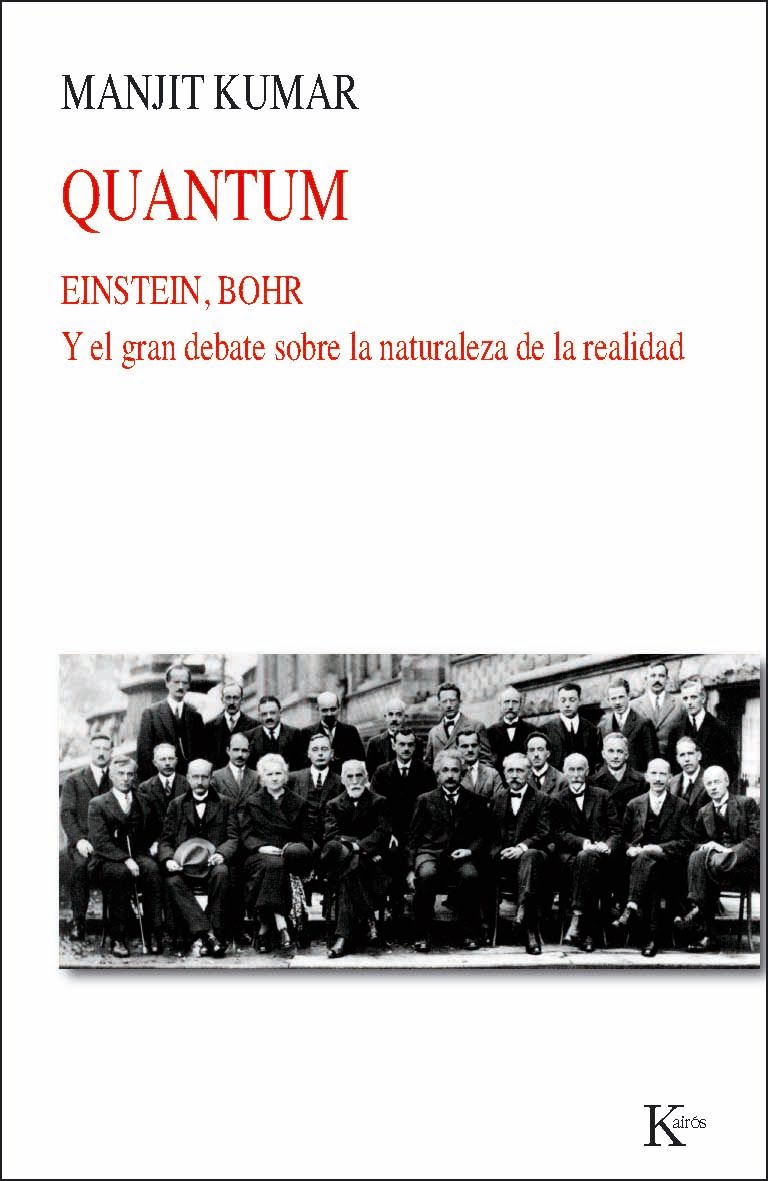
I first saw the photograph of those gathered at the fifth Solvay conference, which was held in Brussels from 24 to 29 October 1927, in a biography of Albert Einstein. This was in 1979, when I was just 16. I wondered what brought these people together, and soon learned that the picture included most of the key players involved in the discovery of the quantum, and the subsequent development of quantum physics. With 17 of the 29 invited eventually earning a Nobel Prize, the conference was one of the most spectacular meetings of minds ever held.


When I was 18, I was given a print of the above photograph as a present. Many years later I began to think about it as a possible starting point for a book about the quantum. In the photograph there are nine seated in the front row. Eight men, and one woman; six have Nobel Prizes in either physics or chemistry. The woman has two, one for physics, awarded in 1903, and another for chemistry, awarded in 1911. It could only be Marie Curie. In the centre, the place of honour, sits Albert Einstein. Looking straight ahead, gripping the chair with his right hand, he seems ill at ease. Is it the winged collar and tie that are causing him discomfort, or is it what he has heard during the preceding week? At the end of the second row, on the right, is Niels Bohr, looking relaxed with a half-whimsical smile. It had been a good conference for him. Nevertheless, Bohr would be returning to Denmark disappointed that he had failed to convince Einstein to adopt his Copenhagen interpretation of what quantum mechanics revealed about the nature of reality.

Instead of yielding, Einstein had spent the week attempting to show that quantum mechanics was inconsistent, that Bohr's 'Copenhagen interpretation' was flawed. Einstein said years later that:

This theory reminds me a little of the system of delusions of an exceedingly intelligent paranoic, concocted of incoherent elements of thoughts.

It was Max Planck, sitting on Marie Curie's right, holding his hat and cigar, who discovered the quantum. In 1900 he was forced to accept that the energy of light, and all other forms of electromagnetic radiation, could only be emitted or absorbed by matter in bits, bundled up in various sizes. 'Quantum' was the name Planck gave to an individual packet of energy, with 'quanta' being the plural. The quantum of energy was a radical break with the long-established idea that energy was emitted or absorbed continuously, like water flowing from a tap. In the everyday world of the macroscopic, where the physics of Newton ruled supreme, water could drip from a tap, but energy was not exchanged in droplets of varying size. However, the atomic and subatomic level of reality was the domain of the quantum.

Bohr discovered that the energy of an electron inside an atom was 'quantised'; it could possess only certain amounts of energy and not others. The same was true of other physical properties, as the microscopic realm was found to be lumpy and discontinuous. Not some shrunken version of the large-scale world that we humans inhabit, where physical properties vary smoothly and continuously, where going from A to C means passing through B. Quantum physics, however, revealed that an electron in an atom can be in one place, and then, as if by magic, reappear in another without ever being anywhere in between, by emitting or absorbing a quantum of energy.

By the early 1920s, it had long been apparent that the advance of quantum physics on an ad hoc, piecemeal basis, had left it without solid foundations or a logical structure. Out of this state of confusion and crisis emerged a bold new theory; known as quantum mechanics, with Werner Heisenberg and Erwin Schrödinger, third and sixth from the right in the back row, leading the way. In 1927 Heisenberg made a discovery. It was so at odds with common sense that he initially struggled to grasp its significance. The uncertainty principle said that if you want to know the exact velocity of a particle, then you cannot know its exact location, and vice versa.

Bohr believed he knew how to interpret the equations of quantum mechanics; what the theory was saying about the nature of reality. Questions about cause and effect, or whether the moon exists when no one is looking at it, had been the preserve of philosophers since the time of Plato and Aristotle. However, after the emergence of quantum mechanics they were being discussed by the twentieth century's greatest physicists.

The debate that began between Einstein and Bohr at the Solvay conference in 1927, raised issues that continue to preoccupy many physicists and philosophers to this day; what is the nature of reality, and what kind of description of reality should be regarded as meaningful? 'No more profound intellectual debate has ever been conducted', claimed the scientist and novelist CP Snow. 'It is a pity that the debate, because of its nature, can't be common currency.'

When Einstein and Bohr first met in Berlin in 1920, each found an intellectual sparring partner who would, without bitterness or rancour, push and prod the other into refining and sharpening his thinking about the quantum. 'It was a heroic time,' recalled Robert Oppenheimer, who was a student in the 1920s. 'It was a period of patient work in the laboratory, of crucial experiments and daring action, of many false starts and many untenable conjectures. It was a time of earnest correspondence and hurried conferences, of debate, criticism and brilliant mathematical improvisation. For those who participated it was a time of creation.'

Planck, Einstein, Bohr, Heisenberg, Schrodinger, Born, Pauli, De Broglie, Dirac, the leading lights of the quantum revolution, are all there in that picture.

Originally posted on Nature.com

Tuesday, 15 March 2011

Paperback of American Edition


This is the cover of the US paperback edition to be published by Norton on 9 May 2011. My thanks to all involved in its production.

Thursday, 3 March 2011

French Edition of Quantum


The cover of the forthcoming French edition. Soon I'll post a round-up of Quantum related stuff from recent months.

Tuesday, 30 November 2010

Quantum makes Booklist's Top Ten for 2010

Quantum chosen as one of the top ten science and technology books of the year by Booklist. They say: 'Kumar illuminates a pivotal episode––Bohr’s triumph over Einstein in their debate over quantum physics––in an accessible and dramatic mix of biography, history, and science.' See the full list here.

Friday, 19 November 2010

Amazon Reader's Review: 'Feeds the brain and the heart'

Steve from Cardiff had this to say about Quantum on amazon.co.uk:

'Like a good novel, this kept me gripped to the very end thanks to a perfect balance between hard science and human interest. The first thing you notice about the book is the detail. Copiously researched, Kumar has pulled together a truly impressive array of material, both personal and professional, constructing a rich history that transports you to the subject's golden age and to the lives of the key players. He tells a story so engrossing and so detailed that I felt surprisingly moved towards the end. Yes, by a book on quantum theory.

In terms of the science, there are some first-class explanations from blackbody radiation and the photoelectric effect through to EPR and Bell's Theorem, with 30+ pages of end notes. Although the history is structured around the debate between Einstein and Bohr, other key players are afforded considerable coverage - not just the obvious ones like Planck, Rutherford, Heisenberg, Schrödinger, de Broglie and Born, but also (and to his credit) some of the lesser known figures - Sommerfeld, Uhlenbeck, Compton - whose crucial contributions to the field frequently go unmentioned in books and articles on this subject.

The great debate itself is a tremendously invigorating one. Both Einstein and Bohr agreed that quantum mechanics was correct. Where they disagreed was in whether or not it was complete. In fact the implications of this disagreement went deeper, calling into question the fundamental role of physics itself, and whether there is even such a thing to be measured as an independent objective reality. On this, the author's background in physics and philosophy are put to good use. Overall then, this is a captivating fusion of science, history, philosophy and biography, and a great way to feed the heart and the brain.'

Monday, 8 November 2010

Top Ten Science Books for 2010 on Amazon.com

Quantum makes the list of the top ten science books on Amazon.com at number 5. See the full list here.

Sunday, 5 September 2010

'This book may be dangerous to your health,' warns reviewer

Jeffery Bairstow, contributing editor of Laser Focus World had to this say about Quantum:

"I think I can safely say that nobody understands quantum mechanics," claimed Nobel laureate Richard Feynman in 1965, some 10 years after Albert Einstein's death. Not even the great father of atomic science himself could have risen to the challenge of sorting out atomic physics just after completing his theses on relativity. "I thought a hundred times as much about the quantum problems as I have about general relativity problems," said Einstein, in the late 1930s. The quantum literally became Einstein's demon.

But wait a minute–now comes a thick new book that purports to cover all you need to know on the thorny subject of quantum mechanics. The book is Quantum: Einstein, Bohr and the Great Debate about the Nature of Reality, by Manjit Kumar. Warning: This book may be dangerous to your health. I almost could not put this book down–I began missing meals and ignoring family member needs.

For once, here is a well-written and highly informative book on a difficult subject. Over the years, I have examined several books by leading authors in this field, but this is the only one that lives up to its title. By reading this book, you may find that you have developed an informed layman's view of quantum mechanics. The book reads more like a novel than a beginning textbook for vigorous demos of proofs.

The book differs from conventional biographies in that it uses a timeline from the days of the pioneers (J.J. Thomson of Britain, Max Planck of Germany, etc.) to contemporary scientists (Anthony Leggett, Richard Feynman, etc.). So what you are reading seems to be a series of essays about Max Planck and the "gang of nine." In rough historical order, the list looks like this: Planck, Rutherford, Pauli, Heisenberger, Bohr, Schrodinger, Einstein, Dirac, Marie Curie, and Bragg. Some list!

Before you read this book, I recommend that you take close look at the first of the B&W photos in the middle of the book. This is a splendid group photo taken at the fifth Solway conference, in October 1927. The two dozen attendees comprise all the key researchers in the field plus a few observers sent to keep their professors abreast of new developments. The assembled brain power is staggering! These meetings were sponsored by Ernst Solvay, a Belgian industrialist who made a fortune from the manufacture of sodium carbonate.

Such "quantum summit meetings" were key conferences for the leading scientists of that time. But there were many larger formal meetings held in London, Berlin, Copenhagen, and other major cities. For example, it was not unusual to have a thousand attendees at the London meetings of the distinguished British Royal Society.

Often the meetings were also supported by leading celebrities of the day. For example, in 1930, the playwright George Bernard Shaw was the master of ceremonies for a lavish fund-raising event at the plush Savoy Hotel in London. Einstein was the guest of honor. Shaw wittily commented that, given the intellectual firepower in the room, "I had to talk about Ptolemy and Aristotle, Kepler and Copernicus, Galileo and Newton, gravitation, and relativity and modern astrophysics, and heaven knows what…"

Shaw then summarized the current state of play as "Ptolemy made a universe which lasted 1,400 years. Then Newton also made a universe which lasted 300 years. Einstein has made a universe and I can't tell you how long that will last." Einstein laughed as loudly as anyone at Shaw's witticisms.

Kumar deftly interposes the developments in quantum physics with the rarely described personal lives of the major players. This combination of the scholarly work with the personal events is rarely attempted with physicists, but Kumar succeeds where others have failed miserably. His sweep is both broad and narrow with surprising success.

Thursday, 2 September 2010

Quantum in the USA

Quantum reviewed in The LA Times on 8 August:

'If thinking about the quantum theory doesn't make you schwindlig (dizzy), then you haven't understood it, Niels Bohr, its great patriarch, famously (well, famously among physicists) remarked. Quantum mechanics lies at the subatomic base of physical reality — and ruptures any attempts to visualize it. This doesn't worry many physicists, who use quantum mechanics to correctly calculate the behavior and attributes of the stupefyingly small and choose to disregard its weirdness. It certainly doesn't worry most nonphysicists; we go about our lives anyway, heedless of the Problem. It worried Albert Einstein profoundly until the day he died. Are you smarter than Einstein?

The British science writer Manjit Kumar has written an intellectual history of the upending, in the 1920s, of classical, Newtonian physics, whose descriptions of an objective, causal reality coincide with our intuition. But quantum theory is counterintuitive. It tells us that a subatomic particle — an electron, say — is in no particular place until it is observed. (Since you cannot see an electron, "observed" here means determining its position experimentally.) It tells us that if you want to know how fast the electron is traveling, then you will have to give up knowing just where it is. It tells us, even, that an electron can be in two places at the same time. The same electron. The various predictions that quantum theory makes have been confirmed in countless experiments.

I recall having all this explained to me in the mid-1960s, over a three-hour lunch in an Italian restaurant in midtown Manhattan, by a frightened science journalist who had just learned that the bit about finding an electron in two places at once had been confirmed by the so-called double-slit experiment. Suffice to say that contemplating this made me and my lunch partner so schwindlig that by the last half-hour neither one of us was sure that the other was actually there. What Bohr might also have said is that once you grasp, however dimly, the implications of quantum theory, your life will never be the same.

This is a very good and thorough history of the quantum revolution, which is not to say that it's a particularly easy read. Unlike many books about physics for laymen, there are no equations in it — except for a couple of "simple" ones about an inch long describing the uncertainty principle, Werner Heisenberg's discovery that you cannot simultaneously determine the position and momentum of a subatomic particle. But the ideas are difficult, as you might expect from the book's subtitle, heralding "the Great Debate About the Nature of Reality."

The principals in this great debate are Bohr, whose physics institute championed the counterintuitive "Copenhagen interpretation" of quantum physics, and Einstein, who objected to Bohr's "renunciation of the representation of a reality ... independent of observation." Einstein believed, to put it simply, that an electron exists — and exists in a particular place — regardless of whether it is being observed. Bohr, and his disciple Heisenberg, believed that "until an observation or measurement is made, a microphysical object like an electron does not exist anywhere," and that "it was no longer possible to make the separation that existed in classical physics between the observer and the observed."

Kumar leads the reader as carefully as he can through the thicket of permutations that led to the completion of the theory and its eventual experimental confirmation (although his description of the Einstein-Podolsky-Rosen paradox, a vain attempt to dethrone it, may make you feel as if you're meeting yourself coming and going). He leavens the mind-bending with sketches of the remarkable human beings involved in this godlike enterprise. Among them: Max Planck, the "reluctant revolutionary" who discovered and named the quantum in 1900, when he was "forced to accept" his own data showing that radiation is emitted and absorbed in packets. The insouciant Heisenberg, young enough to be able to turn his back on classical concepts with no regrets. Erwin Schrödinger, 14 years older, who invented a rival mechanics while vacationing with his mistress in the Alps and refused to accept nature's fundamental discontinuity — even to the point of collapsing on a visit to the Bohrs after a marathon debate with his host ("Bohr sat on the edge of the bed and continued the argument" ). And the acerbic Wolfgang Pauli, nicknamed "The Wrath of God," whose intelligence scared people and who read Einstein's papers on general relativity under his desk in high school "when bored by a particularly tedious lesson."

Pauli is said to have rocked back and forth while he was thinking hard. You might try this on your way through Kumar's book. It's a wonderful trip and one you should embark on if you're interested in just what exactly is at the bottom of the garden.'

Monday, 2 August 2010

'Leaping into the history of quantum theory'

A review from the Providence journal in the US:

'Something deeply hidden had to be behind things,” Albert Einstein thought as a child, thereby expressing the human need and compulsion to see through, behind and beyond the world that we inhabit in order to discover religious truths, scientific laws or cosmic visions.

In this clearly written and understandable analysis of quantum theory, the major discovery of 20th-century physics, Manjit Kumar, who has degrees in both philosophy and physics and is the author of “Science and the Retreat from Reason,” tackles an epic task and interweaves his chronological saga with biographies and backgrounds of all the major physicists who were involved — from Einstein, the “Pope,” to Niels Bohr, the Danish “King,” from Paul Dirac’s silences to Wolfgang Pauli’s sarcastic asides, from French princes to German professors, laboratories and “thought experiments” to the quantum leaps of physicists from the major universities and institutes in Munich, Gottingen, Copenhagen and Berlin.

When Max Planck in 1900 discovered the quantum, “the indivisible packet of energy,” as well as matter, he was unaware that he had destroyed centuries of Newton’s mechanical, deterministic and materialistic vision of the cosmos, undermining notions of gravity and clearly defined orbits.

In 1905, Einstein discovered that light was a particle, made up of quanta, and thus upended the century-long belief in light as a wave, though Newton had thought in terms of particles of light as well. Einstein went on to conjure up relativity, in which matter and energy, forever separate before 1905, became interchangeable, limited only, as in all things, by the speed of light.

Kumar makes the fifth Solvay conference in Brussels in October 1927 the centerpiece of this fascinating, intriguing tale of speculations made and shattered, friendships formed and strained, lavish correspondences that exploded and collapsed, and the heady rush to publish papers in leading journals in order to stake out the latest possible theory and reveal yourself on the cutting edge of the new, confounding vision of the subatomic world.

Politics also intervenes, with the Nazis condemning “Jewish physics” and the flight into exile of many German scientists. At that conference, Einstein and Bohr squared off in terms of what all the quantum mechanics, matrices and wave equations meant, wrestling with one another’s theories in terms not of animosity but of camaraderie.

Bohr had decided that everything was both a particle and a wave — the central conundrum of quantum theory — mutually exclusive but necessary. However, one could measure the radioactive traces of electrons and photons on photographic screens only as particles or waves, never simultaneously. Because he believed that the act of measurement always interferes with and disturbs what we are seeing, we can only see snapshots of the quantum realm. “An unobserved electron does not exist,” he declared. Uncertainty, discontinuity, chance and accident govern all things. Only statistical probabilities worked.
Einstein, on the other hand, believed that the subatomic realm exists independent of human observation. Quantum theory had proved itself, but it was incomplete, and that possibility of incompleteness has dominated the study of physics ever since. How does measurement interfere? Is there a border between the quantum realm and our own?

Kumar has done a splendid job of explaining complex theories and describing the people involved with discovering them, mired in cultural and historical upheavals that haunted all of them. This is a necessary, mesmerizing and meticulous volume.'

'Pulsar' on Quantum

'Pulsar' from Belgium on the League of Reason site gave Quantum this stellar endorsement:

‘I just finished "Quantum: Einstein, Bohr and the Great Debate About the Nature of Reality", by Manjit Kumar.

It's one of the best pop-science books I've ever read, and I cannot recommend it highly enough. The book describes the history of quantum mechanics, notably the first three decades of the 20th century, and all the major characters involved - physics, biographic info and European history are intertwined into a real page-turner. It's absolutely fascinating to see how Planck, Einstein, Bohr, Rutherford, De Broglie, Born, Pauli, Dirac, Heisenberg and Schrodinger constantly inspired each other in their obsession to understand atoms and radiation.

The central part is the Great Debate between Einstein and Bohr about the Copenhagen Interpretation of QM, the relation between physics and reality, and Bell's theorem to test the completeness of the theory. I must say, this book shows Einstein's views of QM in a way I knew little of. Often, Einstein is depicted as a relic who couldn't keep up with the latest physics and never really 'got' QM. But in reality he knew damn well what he was doing (and he convinced Schrodinger, who came up with his cat thought experiment). The standard interpretation of Bohr has dominated the teaching of QM ever since, but this book asks the question whether this domination is really justified. It might be time for a new revolution in physics...

A must-read!’

Book addict on Quantum

'Addicted to books' blogger Tracy had this to say about Quantum:

'This book is a gem, a history of quantum mechanics, not just about Einstein and Bohr, but about those other giants of physics and their discoveries - Planck's original accidental discovery of the quantum, Rutherford's discovery of the atomic nucleus, de Broglie's wave-particle duality, Pauli's exclusion principle, Heisenberg's uncertaintly principle, and Schrödinger's wave equation (and infamous cat). More than this, Kumar's book brings those Nobel prize-winning scientists to life - Heisenberg's rivalry with Schrödinger, Pauli, the sharp-witted Austrian who rarely surfaced before noon, de Broglie, both a German prince and a French duke and the quiet Englishman Dirac, bullied by his overbearing father.

Having brought you up to speed on the nature of quantum mechanics, lucidly explaining both the experimental evidence and the thought experiments beloved of Einstein, the author then hits you with the real argument, the interpretation of quantum mechanics: What does it really mean? What is the nature of reality? In the 'observer-independent reality, quantum theory is incomplete ' corner was Einstein, whereas Bohr and the majority of quantum physicists at the time were very much in the 'probablistic, observer-dependent reality' corner - Einstein's famous argument that 'God does not play dice with the Universe' countered by Bohr's response of 'But still, it cannot be for us to tell God, how he is to run the world.' And still the debate continues.

Manjit Kumar's book explains the science and the arguments beautifully-clearly and fairly. Highly recommended to anyone who likes science history and essential reading for anyone who is studying any kind of science. The kind of book that really does make you feel slightly more intelligent after you've read it, for a few weeks, anyway, until you forget Pauli's exclusion principle (no two electrons in an atom can occupy the same quantum state), de Broglie's equation linking wavelength and momentum gradually fades, Planck's constant, h, draws a blank and all you're left remembering is Schrödinger's cat, his famous thought experiment about a cat in a box, whose fate is determined by random radioactive decay of an atom.'

Lessons for today from the Golden Age of Physics

Norman Lewis posted this insightful piece at www.futures-diagnosis.com which I'm taking the liberity of reprinting here:

WHEN RESEARCH MAKES QUANTUM DEVELOPMENT SENSE
The call this week by Lord Browne, the former BP chief executive, for a sweeping review of the UK’s £4bn-a-year science budget to emphasise projects with the potential to bring short-term industrial benefits, has sparked a fury amongst scientists. (See ‘Common room clashes with boardroom on science budget’, Financial Times. This is precisely what we warned against in the Big Potatoes Manifesto where we argue in principle 4 ‘For Useless Research’ that research remains the bedrock upon which the flow of innovation ultimately depends – a bedrock that is increasingly being questioned and undermined in our short-termist recessionary times.

Lord Browne’s instrumentalism certainly makes re-stressing this point timely and urgent. But the correctness of this fundamental research proposition was forcibly driven home to me during my recent holiday when I had the luxury and sheer delight of reading Manjit Kumar’s tour de force Quantum: Einstein, Bohr and the Great Debate About the Nature of Reality .

This is an absolute must for all those supporters of Big Potatoes. It describes in a remarkably entertaining and accessible fashion, the history of science’s fundamental revolution – quantum physics and mechanics – and the remarkable intellectual battle between Albert Einstein and Niels Bohr and other brilliant young scientists who were at the heart of this inspiring story.

More importantly, it reveals some critical insights into the processes and interactions that led to a scientific revolution which gave rise to the innovations we now take for granted: the transistor, the computer, the World Wide Web, the communications revolution.

UNEXPECTED OUTCOMES
Kumar shows that when these great physicists formulated quantum mechanics from 1900 to 1930, they were trying to understand the fundamental laws of the universe, not invent something of great economic importance. Their quest was the sheer beauty of solving some of the most baffling and abstract theoretical questions. The implications of their quest were so far-reaching it impacted almost everything, transforming sister disciplines like chemistry, for example. Today, all chemists and material scientists are trained extensively in quantum mechanics. Biologists like Francis Crick, who won the 1962 Nobel Prize in Medicine for the discovery of DNA, realized many years ago that the laws of physics and quantum mechanics ultimately govern even biology.

Quantum mechanics is necessary to engineer solid-state devices such as transistors, which are the building blocks of electronics and computers. Understanding semiconductors (the building blocks of transistors), or any material cannot be fully grasped with classical physics alone (i.e. physics known before the discoveries of quantum mechanics and relativity). Without quantum mechanics, the “information age” (and much of modern science) would not exist today. The inventions of the computer, the transistor, the World Wide Web and the laser used in fibre optics, (the basis for a global telecommunications industry) owe their existence to quantum mechanics and are worth trillions of dollars.

But to stress this point again, these were unexpected outcomes. The pursuit was science, the quest for purity and the beauty of an unassailable proof – and a closer approximation of reality.

There were three things about the book that really caught my attention, which are so germane to the debate we have started with the Big Potatoes Manifesto:

THE ‘LIMITS’ OF HUMAN KNOWLEDGE
Kumar relates the story about Max Planck, the father of Quantum who at the age of sixteen enrolled at Munich University to study physics because of his burgeoning desire to understand the working of nature. Planck spent three years at Munich which were to have a big impact on him, mainly because he was advised to give up physics as ‘it is hardly worth studying physics anymore’ because there was nothing important left to discover. Planck went on to become the father of quantum mechanics because, as he discovered, there was certainly a lot more to discover about how the world works. Planck reacted against the narrowness and conservatism of his peers. He defied the attitude, which we seem to accept today, that mankind had somehow reached the limits to knowledge. Instead his openness and willingness to question existing orthodoxy unleashed a scientific revolution, the creation of new knowledge and ultimately, the development of remarkable innovations that changed life in the 20th century.

PEERS COMMITTED TO THE GREATER GOOD
The second striking point Kumar brings out in his examination of the interaction of this extraordinary group of scientists was their willingness to engage each other as professionals in a common quest for truth. First, what united them was a belief in objective truth. Second, that despite different opinions (and often bitterly at odds) they were nevertheless united as pioneers committed to something greater than themselves.

This is illustrated by the example of Max Planck’s endorsement of Einstein for membership of the Prussian Academy of Sciences in 1913 despite fundamentally disagreeing with his position on light-quanta. Planck’s proposal contained the following paragraph: ‘In sum, it can be said that among the important problems, which are so abundant in modern physics, there is hardly one in which Einstein did not take a position in a remarkable manner. That he might sometimes have overshot the target in his speculations, as for example in his light-quantum hypothesis, should not be counted against him too much. Because without taking a risk from time to time it is impossible, even in the most exact natural sciences, to introduce real innovations’ (p52)

Not only do we see a remarkable willingness to recommend a fellow scientist despite disagreeing with him but the clear connection between disagreements and risk as critical to scientific advance.

What a stark contrast with today where contestation is regarded as a religious infraction against ‘truth’ (as in the ‘Climategate’ debacle) and where risk is consciously prevented by concentration on what we already know or what Lord Browne thinks can be safely developed. Planck reveals what science is really about in contrast with today’s instrumentalism and manufacture.

THE BEAUTY AND NOBILITY OF SCIENCE
The third and final striking point in the book is the nobility of the young scientists involved in this rich period of scientific discovery. For them, as in the example of Ernest Rutherford, exploiting their research for financial gain was seen as a distraction from the really important goal of making a scientific reputation for themselves. Rutherford who had started working on the detection of ‘wireless’ waves (radio waves) chose instead to pursue his academic passion (in contrast to others working in this field like the Italian Guglielmo Marconi who amassed a fortune).

This is not to suggest that exploiting scientific discoveries were wrong or that the people who did were somehow flawed. Far from it. It highlights how the pursuit of science requires those types of individuals who regard it as a noble calling and are given the freedom to pursue it regardless of measurable outcomes (as we would have it in today’s crude management-speak). Kumar reveals how the young men at the centre of the quantum revolution were driven not only by their own self- belief (and no doubt, huge egos), but also by the pursuit of something greater than material wealth – a belief in scientific and human progress.

Of course that is precisely what is being questioned today, which is why the media concentrates its attention on the exploiters of science rather that present-day pioneers. So the founders of Google are feted for creating Google whereas in the past we would be looking for the scientific contribution they might have made towards humanity’s body of knowledge. Today we celebrate exploitation rather than the wonder of science underpinning these achievements.

The question this raises is how we will ever create a culture that places greater value in the pursuit of knowledge rather than on its results?

As the world discovered through Max Planck, everything had not been explained. Kumar’s book is a great reminder that there is no such thing as natural limits and that the worst dimension of a culture of limits is that it constrains the thing we have an abundance – human ingenuity, perseverance and the noble ability to rise above petty egos, jealousies and parochialism to benefit humanity as a whole.

Kumar’s book is definitely Big Potatoes and should be read widely.

Born with Quantum history in the family

Carey Born, the granddaughter of the Max Born, the great quantum physicist who was instrumental in the development of matrix mechanics (he even taught Heisenberg what a matrix was) and put forward the probabilistic interpretation of Schrodinger's wave function (for which he was awarded the Nobel Prize) wrote this on amazon.co.uk:

'Manjit Kumar has produced a brilliant, insightful account of the quantum story. Through a compelling narrative he interweaves the ideas, events and personalities involved in the paradoxical quest for the truth about uncertainty. The book is a fascinating read about this tumultuous and revolutionary period in the history of science. Highly recommended'.

Another reader's view of Quantum

'A brilliant read', says Steve Carleysmith on amazon.co.uk

'I found this a fascinating read. If you are interested in how science works and the power of personalities, you will love this book. Using really well researched personal details of the lives of the key figures, Kumar shows how quantum science developed and led to the scientific and philosophical conflict between Bohr and Einstein - a debate that continues to this day. What is real and what is only observed? Kumar blends biography and quantum theory, covering probably the most exciting period in the development of science and thought.'

'A book that is very difficult to close... maybe it's in a state that is both open and closed until you look at it, who knows?'

It was the the title of this review by C.A. Whitfield on amazon.co.uk that caught my eye. He or she writes:

'This has to be one of the most gripping non-fiction books I have ever read! It reads like a well-organised narrative and there is rarely a dull moment in the entire book, although the author did have plenty to work with. As well as the emergence of this controversial 'quantum physics' the scientists had to compete with the outbreak of two world wars, it was not an easy time to be a theoretical physicist.

The chapters each focus on a different player in the quantum debate so that the reader gets a taste of the characters' backgrounds and their individual work that all led to the great breakthroughs that were made. This means that by the point in the story when all the characters are starting to meet and debate the implications of quantum mechanics, the reader finds they know their personalities and are compelled to find out who comes out on top.

Any physics that is mentioned in the book is explained thoroughly and generally only goes into as much detail as is necessary for the reader to understand the debate. This can get slightly tedious at times for anyone with a background in physics but it does mean that the book is suitable for anyone.

Overall, it is a fascinating and compelling read that find an exciting balance of scientific content, concerning what still is one of the most mysterious areas of physics, and the personal experience of the people involved.'

Quantum in Canada

Here's a review by Dr Stefan Miesbach on Amazon Canada:

'Manjit Kumar's "Quantum" is an absolute page turner. I could hardly put it away and wanted to read it all over again once I came to the end. There is not a lot of new content which cannot be found in biographies or other expositions of the quantum struggle, which ended with Copenhagen. What makes this book unique is a high-pace narrative style pulling the reader from one chapter with one fundamental discovery into the next combined with an almost uncanny ability of the author to unfold most complex physical and philosophical concepts at that same high pace. The narrative also makes the discussions, tensions and emotions so vivid that one feels compelled to jump right into the scenes to hear the debates first hand.'

Reader's review from amazon.com 3

'Quantum of Delight' wrote Unfallen. And then went on write:
'A masterful balance of theory and history, Quantum is an engaging dip into one of the most fascinating streams of modern scientific discovery. The book includes simple, carefully calibrated explanations of the most important theories but does not get bogged down by them. The real story here is the colorful pioneers who explore the mind-boggling terrain that is the quantum world. The author fills his account with insightful portraits, revealing encounters, and one or two hilarious anecdotes which both humanize the major players and illuminate their astonishing genius. His style is accessible but never fritters. In fact, I think this material could be adapted for a marvelous course by "The Teaching Company." I think I'll tell them about it.'

Reader's review from amazon.com 2

'A lot has been written about the Bohr-Einstein debate so when I first saw this book I did not buy it because I was skeptical about what more could be said. On reading other reviews I decided it might be worthwhile', said J Alia.

'Many scientists I've met are still passionate about the implications of quantum mechanics, Einstein's criticisms of the theory and Bohr's responses to those criticisms. Many scientists who are not outwardly enthusiastic about the debate and history seem to have approaches toward science that are influenced by it. (just my opinion). In any case, the subject of this book is fascinating.

Of the books I have read about this topic this one may be the best read.'